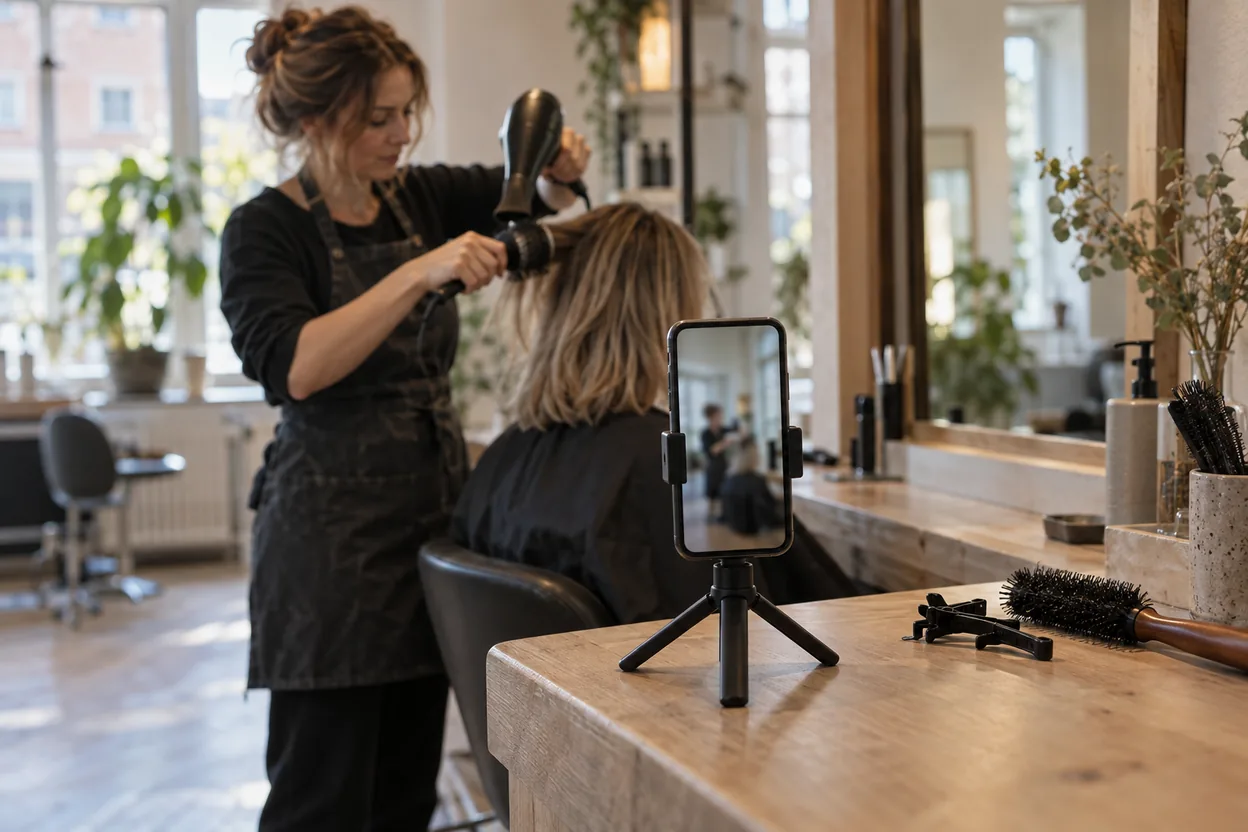
A salon has something most businesses lack on TikTok: the work is visible. Hair, nails and lashes change in front of the camera in an hour or two. That goes a long way towards filling an account, as long as you know what to film and which rules apply to a business.
Here are 30 ideas for hairdressers, barbers, nail salons and beauty salons, in five groups. Most come with a hook for the first few seconds or a suggested caption. Three rules apply from the very first video: a business account may only use music from TikTok’s Commercial Music Library, sales-led videos must be labelled as advertising, and everyone on camera must have said yes. We cover the rules after the ideas, together with how often you need to post and how a video turns into a booking.
We are based in Sweden, so the figures and laws in this guide are Swedish and labelled as such. TikTok’s own rules apply everywhere. If you run a salon elsewhere, check your own country’s rules on advertising disclosure and consent.
As of 15 October 2026. TikTok changes its features and rules often, so everything about the platform is dated. Sources are listed at the end.
Who you reach on TikTok
In Sweden, TikTok mainly reaches young people. According to Svenskarna och internet 2026, the annual survey by the Swedish Internet Foundation, 22 percent of internet users have used TikTok in the past year, and 15 percent use it daily. Among people born in the 2000s the figure is 69 percent. Among adults aged 20 and over, 16 percent have used TikTok, compared with 69 percent for Instagram.
If your salon has lots of young clients, for example before proms and graduations, TikTok is a natural channel. If most of your clients are adults, the same videos will reach more people as Reels on Instagram, and further down we explain how to post one film on both. Whether TikTok is worth your time at all is covered in our decision guide on TikTok for local businesses.
Four things that apply to every idea
We use TikTok’s own advice for ad videos as a rule of thumb for ordinary videos too:
- Film vertically in 9:16, at least 720p. A phone on a stand by the chair is enough.
- Hook first. TikTok advises advertisers to show what the video is about within the first 3 seconds and to put the hook within the first 6. Start with the result, the question or the unexpected, not with “hi and welcome”.
- Show people and keep it simple. TikTok recommends showing people, such as employees or customers, and a style that is not too polished, so the video fits in with what users post themselves.
- Say what it is and where you are. TikTok weighs captions, sounds and hashtags, among other things, when recommending videos, and a video can be found through search even if it doesn’t reach the For You feed. Write something like “Balayage on mid-length hair, hairdresser in [area]” rather than just an emoji.
Transformations and before/after
This is the format most people associate with salons on TikTok. Put the phone in the same spot every time. That keeps the comparison fair, and you don’t need a colleague to hold it.
- After first, then the journey. Show the result in the first second, rewind to before and show the process in fast motion. 15–30 seconds is enough. Hook: “This is what it looked like two hours ago.”
- The colour journey over several visits. A big colour change is often done in stages. Film each visit and say how many it took, so the client has the right expectations before booking. Caption: “Three visits in four months, from dark brown to light.”
- The fade in close-up. For barbers: the camera close to the blend, from clippers to scissors. The sound of the clippers is all the soundtrack you need. Hook: “A fade in 40 seconds.”
- From natural nails to the finished design. Start with the hands before and end with a close-up of the last detail. Show the same design in two lengths, so viewers can see what would suit them.
- Lashes and brows, before and after. Lash lift, extensions or lamination, close to the face and in the same light. The face is visible here, so consent matters even more.
- What it looks like after six weeks. Ask a regular for a short clip at their next visit: how the colour, nails or lashes have held up. It answers the question many people have before booking: how long does it last?
Tips and “don’t do this”
Advice from the chair is the easiest content to make without a client on camera. One person, one question and one answer in under a minute. Pick questions you actually get, then you know someone is wondering.
- Don’t try this at home. A mistake you see every week, such as peeling off gel polish yourself or bleaching over old box dye. Show why it goes wrong and what the client can do instead. Hook: “I see this every week.”
- How to describe what you want. The difference between highlights and balayage, between a lash lift and extensions, or what “just a trim” means at your salon. Use the words your clients use, both in the video and in the caption.
- How often do you need to come in? The honest answer about intervals: when colour needs a refresh, when nails need infills and when a fade grows out. End with where to book.
- One technique in 20 seconds. How to use a round brush, how to make curls last until the evening, or how to look after new lashes in the first 24 hours. One technique per video.
- Myth or not? Claims you hear in the chair, and what you say as a professional. Don’t promise results you can’t stand behind.
- The right amount of product. How much shampoo, hair oil or cuticle oil is actually needed, shown in the hand. If the brand gave you the products, it is a partnership and must be labelled.
Behind the scenes and the team
This is where you show who stands behind the chair, so the salon feels familiar before the first visit. Everyone on camera must have said yes, colleagues included.
- The morning before the first client. Tools laid out, stations set up and the coffee on. 15 seconds, no talking. Show how you clean your tools, too.
- Meet the team member. One person, one speciality and something they love about the job. 15–20 seconds, one video per person.
- The practice head. Apprentices and new colleagues training on a mannequin head or practice nails. It shows the craft without any client needing to appear.
- A day in the salon in 30 seconds. Short clips from the whole day, from the first client to lights out. Cut the faces of clients who haven’t said yes.
- The delivery arrives. New colours, polishes or tools being unpacked. If a brand gave you something for free, it is a partnership, and the video must be labelled.
- The sound of the salon. Scissors, hairdryer, shampoo and the file against the nail. Close-ups and original sound only, which is also the easiest way to avoid the music question.
Products and treatments
This is where you sell most directly, so this is where the ad disclosure must always be in place. Say what the treatment is called, roughly what it costs and how to book.
- What a first visit looks like. What happens when you book colour, lashes or a facial for the first time: the consultation, the time it takes and what to think about beforehand. It removes what makes a first visit feel uncertain.
- What does it cost, and why? Walk through a treatment and what the price is made up of: time, materials and steps. In Sweden, if you mention a price it must be the full price the client pays, including VAT (Price Information Act, section 2).
- Two treatments side by side. Gel polish or builder gel, lash lift or extensions, highlights or balayage. Who suits which, how long they last and how they differ in time and price.
- What we use, and why. A product you work with, shown in use. If you sell it in the salon, say so.
- The season ahead. Graduation styles, proms, weddings and Christmas come round at the same time every year. Post examples a few weeks ahead, together with when bookings open.
- Free slots this week. A quick video of the gaps you have and what fits in that time. Short, sales-led and labelled as advertising.
Trends, with sounds business accounts may use
A trend on TikTok is often two things: a sound and a format. You can only use the sound if it is in the Commercial Music Library. You can always borrow the format, with your own sound or a track from the library. With a verified business account, you also get access to TikTok’s Creative Hub, where you can search trending content for inspiration.
- Get ready with us (GRWM). The format where someone gets ready for something, salon-style: from everyday hair to a prom updo, with the client explaining where they are going. Needs a clear yes.
- POV from the chair. Short scenes from salon life with on-screen text, such as “POV: the client says ‘just a little shorter’”. Joke about the situation, never about a real client.
- The professional’s answer, with Stitch. A viral hair hack or nail tip that you can explain, correct or test. With Stitch, you use a clip from someone else’s video in your own, if the creator has allowed reuse. Add something of your own: TikTok treats content largely repurposed without creative edits as unoriginal, and it can be removed from the For You feed.
- The list in text. “Five things I never do as a hairdresser”, one point at a time on screen, with salon sound or a track from the library.
- What the client asked for. The client explains in their own words what they wanted, then you show the result. Don’t show the inspiration photo the client brought: the person in the photo hasn’t said yes, and the picture belongs to someone else.
- One cut, three styles. The same haircut styled for everyday, a party and the gym. It shows what the client can do at home after the visit.
Before you post: music, ad disclosure and clients on camera
Most of this takes an evening to set up. Consent from the people on camera, however, cannot be sorted out afterwards, so start there if you only have time for one thing.

A verified business account
TikTok says that anyone whose primary goal is to promote their business, whether a product or a service, should use a Verified Business Account. If someone also wants to post personal content, TikTok recommends two separate accounts. You switch in the app under Settings and privacy, then Account and Business verification. You submit your business details and documents, and according to TikTok it can take up to five business days before the verification is complete. Do it before you start posting, ideally while you film your first ideas.
A verified business account can add a link to your booking page in the profile straight away. A general account needs at least 1,000 followers before it can add a link.
Music: Commercial Music Library only
Verified business accounts do not have access to TikTok’s general music library, because, according to TikTok, those tracks are not cleared for commercial use. They only see tracks from the Commercial Music Library, which are pre-cleared for commercial use and can be searched and filtered by theme, genre, mood and length, among other things. According to TikTok, businesses may not use the general library for commercial purposes at all.
In practice, that means three things:
- A personal account doesn’t solve it. Posting the salon’s videos from a personal account to get at a trending track does not make the track allowed in marketing.
- Your own sound is always fine. Voices, scissors, hairdryers, chat at the chair and shampoo lathering.
- Turn off the salon music while you film. The song on the speaker ends up in the video too.
Ad disclosure: the setting and the word “advertisement”
TikTok’s Community Guidelines, in the version effective from 24 September 2026, require you to label commercial content when you promote your own business. Before posting, you turn on the Disclose commercial content setting and choose that it is your own brand. You can also turn it on for a video that is already live. According to TikTok, undisclosed content may get reduced reach or have the setting applied by TikTok, and repeated failure can lead to a temporary posting restriction or a banned account.
Swedish law says the same thing in different words. All marketing must be designed so that it is clearly identifiable as marketing (Marketing Act, section 9). The Swedish Consumer Agency writes that the starting point is that all posts a business publishes about its own products are covered, that advertising posts on social media should be labelled with the word “reklam” (advertisement), and that this must be clear at a glance. In Sweden, write Reklam at the start of the caption, or as on-screen text in the first few seconds.
Where is the line for a pure tips video? The simplest approach is not to look for it. Label everything that shows your treatments, prices, free slots or offers.
If a brand has given you products or paid you to show them, it is a partnership. Then also turn on the Branded content option, and label it as advertising.
Clients and staff on camera
In Sweden, the Act on Names and Images in Advertising is short. A business may not use another person’s image in marketing without that person’s consent, and the ban also applies to employees and others who post on the business’s behalf (section 1). Anyone who breaks the law may have to pay the person reasonable compensation (section 3). The GDPR applies too. According to the Swedish data protection authority (IMY), consent must be freely given, specific, informed and unambiguous. You must be able to show it afterwards, and it must be as easy to withdraw as to give.
That applies to clients, and it applies to staff who appear on camera. Here is how to handle it in the salon:
- Ask before you start filming, not when the video is finished.
- Use a short written consent: what is filmed, where it is published (TikTok, Instagram, your website) and how the person withdraws their yes. Keep it.
- Offer a version without a face: hands, the nape of the neck or hair from behind.
- Remove the video if someone changes their mind.
- Nobody should have to appear on camera because it is expected. A colleague’s no is a no.
- Children: ask the parent or guardian, and consider whether the child needs to appear at all.
No filters on the result
A before-and-after with a beauty filter does not show your craft. The Swedish Marketing Act prohibits presentations that are misleading about your own business (section 10). TikTok also requires labelling when AI or significant editing shows realistic-looking people or scenes in a way that could confuse, while colour correction and cropping do not need a label. An AI-generated “after” photo has no place in a salon’s marketing at all. The same light and the same angle before and after is what makes the comparison credible.
Treatments with needles or incisions
TikTok’s Community Guidelines class treatments that cut the skin or use needles to change someone’s appearance as invasive cosmetic procedures. Marketing them is not allowed, except in some regions for verified business accounts and TikTok Shop sellers that meet TikTok’s requirements. Content that shows or promotes invasive cosmetic surgery, or discusses cosmetic surgery without explaining the risks, is not eligible for the For You feed and is age-restricted.
In Sweden, aesthetic injection treatments may only be given by a licensed doctor, dentist or nurse, and never to anyone under 18 (Act on Aesthetic Surgical Procedures and Aesthetic Injection Treatments, sections 8 and 9). If you offer fillers or injections, don’t build your TikTok account around them. TikTok’s definition mentions needles without giving examples. Our reading is that treatments such as microblading and microneedling may be covered as well, so read the rule before you film them.
How often do you need to post?
TikTok does not give a number of videos for businesses, and says there is no one-size-fits-all answer. According to TikTok’s own description of its recommendations, neither follower count nor previous high-performing videos are direct factors. Recommendations are based on how viewers interact with videos and on information about the video, such as captions, sounds and hashtags.
Our assessment in the guide to the best time to post and how often is two or three videos a week that you can keep up for a quarter, and at least one a week. That is a better start than a video a day for two weeks. Thirty ideas last ten weeks at three videos a week, or seven months at one a week. Film several ideas back to back on a quiet morning, and you have several weeks ready.
The same video on Instagram
Save the original file before posting to TikTok and upload it as a Reel on Instagram, not a downloaded TikTok video with a watermark. Instagram wrote in 2023 that reels with a visible watermark are shown to fewer people. Add sound and text in each app separately. In Sweden, 46 percent of internet users use Instagram daily and 15 percent use TikTok (Svenskarna och internet 2026), so for many salons Instagram is where the film reaches the most people.
From video to booking
A video that lots of people watch but nobody books from hasn’t done its job. Five things connect TikTok to your calendar:
- The profile says what, where and how. For example: “Hairdresser and barber in [area]. Walk-ins on Tuesdays. Book via the link.”
- The link goes straight to booking. With a verified business account you can add it right away, otherwise you need 1,000 followers. TikTok recommends direct links, so viewers get where they are going in a few steps. Link to the booking page, ideally to the right treatment, not to the home page. Links that open other social media apps are not supported.
- Every sales video ends with the next step. Say what the treatment is called, roughly what it costs and “book via the link in our profile”. Add the same as text at the end.
- Reply the same day. A question about price or free slots in the comments or in a message is often a booking waiting to happen.
- The same details everywhere. Name, address, treatments and prices should match across TikTok, your Google Business Profile, your website and your booking system. What the foundation looks like for a salon is covered in visibility for hairdressers and visibility for beauty salons.
Then measure bookings, not views. Ask “How did you find us?” in the booking form or at the till, and count how many say TikTok. The analytics in the app show how each video performs and whether any video has been made ineligible for recommendation, so look there before you change everything.

Don’t let TikTok become your only channel. The reach there is rented: the platform decides the feed and the rules, as we explain in why you shouldn’t depend on Instagram or Bokadirekt alone. If you want a video that already works to reach more people, you can pay to promote it with the Promote tool in the app.
Getting help with the videos
Filming, editing and posting takes time that would otherwise go to clients. With us, TikTok is part of Premium, SEK 2,995 a month excl. VAT: Reels and TikTok content and video every month. Premium builds on Plus, which includes 8 posts a month on Instagram and Facebook, a photo visit every quarter (the first at the start) and monthly follow-up. The foundation includes your website, hosting, local SEO and a review of your Google Business Profile. We create the material from your business, you approve everything before it is published, and you own the accounts.
There is no setup fee, no lock-in and one month’s notice, and you keep your price for as long as the agreement runs. Replying to comments and messages is not included, and is quoted separately and in plain text before you say yes. If you want help with social media without a website from us, that is possible too, and we quote it on request. How we work is described on our social media page, the terms on our pricing page, and how the cost of social media help compares overall in What does social media help cost?
Sources
All web pages read 14–15 October 2026 unless otherwise stated.
- TikTok, Community Guidelines (released 25 August 2026, effective 24 September 2026)
- Regulated Goods, Services, and Commercial Activities (commercial disclosure, invasive cosmetic procedures)
- Mental and Behavioral Health (cosmetic surgery in the For You feed)
- Integrity and Authenticity (AI-generated and edited content, reused content)
- For You feed Eligibility Standards (search and analytics)
- TikTok, Help Center and Creator Academy
- Account types on TikTok (business account, verification, music, link, Creative Hub, Promote)
- Add a website link to your profile
- Stitch privacy settings
- TikTok originality policy, updated 26 September 2026
- Posting cadence tips for all industries, updated 6 July 2026
- How TikTok recommends videos #ForYou, 18 June 2020
- TikTok for Business
- Commercial Music Library, July 2025
- How to use the Commercial Music Library, July 2026
- How to turn on the Commercial Content Disclosure setting in TikTok, January 2026
- Creative best practices for performance ads, June 2025
- Instagram: Instagram Ranking Explained, 31 May 2023 (watermarks in Reels)
- Swedish Internet Foundation: Svenskarna och internet 2026, social media chapter (in Swedish), 28 September 2026. Base: internet users aged 8 and over, responses collected in January 2026.
- Swedish Consumer Agency (Konsumentverket): Hidden marketing in social media, rules for businesses (in Swedish), reviewed 4 September 2026
- Swedish data protection authority (IMY): Consent (in Swedish)
- Swedish legislation (lagen.nu, in Swedish)
- Marketing Act (2008:486), sections 9 and 10
- Act on Names and Images in Advertising (1978:800), sections 1 and 3
- Act on Aesthetic Surgical Procedures and Aesthetic Injection Treatments (2021:363), sections 8 and 9
- Price Information Act (2004:347), section 2