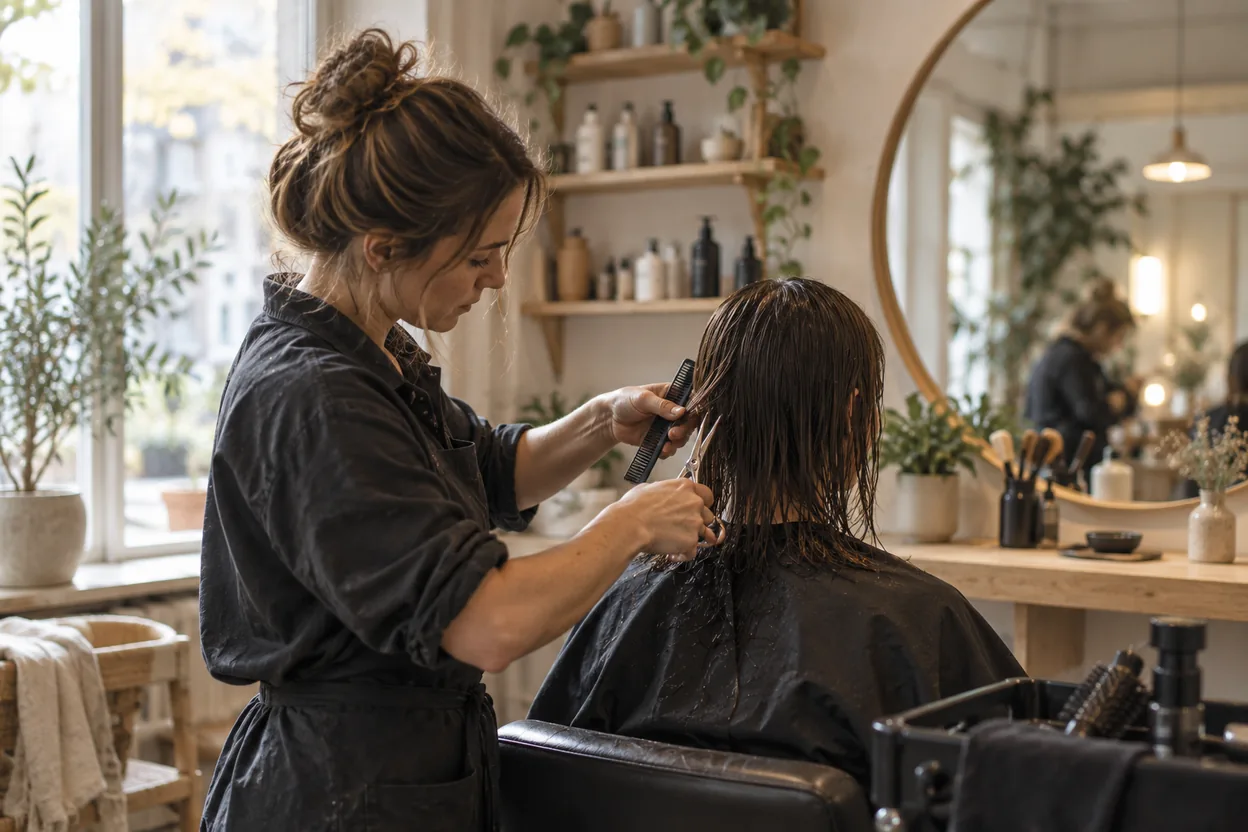
The hairdressing industry is one of the most visibility-driven local industries in Sweden. Few new customers find a hairdresser through ads. The vast majority find them via a Google Maps search or Instagram, do a quick evaluation on reviews and photos, and book.
That means local visibility is decisive. Not optional. And it also means the levers that work for hairdressers are specifically visual and review-focused.
Here’s what actually works.
In the Swedish hairdressing industry two platforms are specifically critical beyond Google: Bokadirekt and Instagram. Bokadirekt acts as the de facto booking engine for a large share of Swedish salons, customers looking for a new hairdresser often land there before they even check your website. Instagram is where the visual demonstration of competence happens. A hairdresser without a strong presence on at least one of those two platforms consistently loses customers to competitors who have it.
Google Business Profile + Maps, the bedrock
For hair salons the Local Pack and Google Maps are usually the single biggest visibility source. When someone searches “hairdresser Vasastan” or “barber Linnéstaden”, it’s the three profiles under the map that draw the majority of clicks.
Specifically for hairdressers:
- Primary category: “Hair salon” if the mix is hair. “Barber” if primarily men’s cuts. “Beauty salon” if broader mix. If treatments are the main business, our guide to visibility for beauty salons is the better fit.
- Subcategories: Add what’s relevant, “Skincare salon” if you do treatments, “Nail salon” if nails.
- Services: List everything with price (“Men’s cut 450 SEK”, “Short-hair colour from 850 SEK”).
- Photos: The hairdressing industry needs many photos. 30+ recommended. Mix of premises, staff, before/after cuts, products.
- Posts: Weekly is the minimum. Seasonal offers, drop-in times, new styles.
We’ve written a deep guide on this in Google Business for local businesses.
Reviews with text, more important than the number of stars
For hairdressers, reviews are what often decides which of three equivalent salons the customer clicks on. And the text in reviews is more valuable than the stars.
Active strategy:
- Ask after every visit via SMS the next day
- Ask specifically for text (“a few lines about the experience”)
- Direct link to GBP review page
- Respond to all within 48 hours, especially important in the hairdressing industry where personal service is central
Goal: 50+ reviews within the first six months for a new salon. For established: a consistent flow of 4-8 new/month.
Before/after photos, the strongest visual proof
For hairdressers this is one of the most convincing social proof formats. Show concrete results.
On the Google Business Profile: add regularly (one per month is enough).
On Instagram: weekly if possible. This is what drives reach for hairdresser accounts.
On TikTok: transformation format works extremely well, if you have time. More in TikTok ideas for salons.
On the website: have a dedicated gallery section or integrate into service pages.
Ethics: always ask the customer’s permission, even for before photos. Offer not to show the face if the customer prefers.
Dedicated service pages per main service
For Google: a single page called “Services” with a list of everything ranks worse than five dedicated pages (one per main service).
What you should have:
- Men’s cuts (own page)
- Women’s cuts (own page)
- Beard trim (if you do)
- Colour (if you do)
- Special treatments (cures, balayage, etc.)
Each page with:
- Description of the service (what’s included, for whom)
- Price (or “from-price” + explanation)
- Time required (“about 60 min”)
- Photos from those jobs (3-5)
- A FAQ section
- Clear “Book [service]” CTA
This helps both Google (specific keywords rank specific pages) and the customer (concrete information).
Booking without friction, where the customer’s decision often gets lost
Hairdresser bookings are a high-frequency business, many small bookings daily. Friction in the booking system can make or break the conversion from interested visitor to booked customer.
Good practice:
- Booking system integrated with GBP (Bokadirekt, Timma, Booksy)
- Booking on the website without login for new customers
- Drop-in times marked in Stories and as GBP posts
- Clear “Call us” if you prefer phone bookings
Especially for booking systems: check that they don’t require an app download for a new customer. That’s one of the biggest friction points.
Bonus: What you don’t need to spend energy on
For most hair salons these are lower priority:
- Facebook activity (Instagram + Google go a long way for younger customers)
- Daily posting on social media (2-4 posts/month is enough)
- Ads before the organic foundation is in place
- A blog (rarely big returns specifically for the hairdressing industry)
A typical hairdresser’s visibility stack
For a typical local hair salon that wants to be competitive:
Must-have:
- Verified and optimised Google Business Profile with 30+ photos
- 30+ Google reviews with a consistent flow of new ones
- Website with dedicated service pages + booking
- Active Instagram (2-4 posts/month + stories)
Nice to have:
- TikTok presence with 4-5 videos/month (if time allows)
- Embedded Google reviews on the website
- Before/after gallery on the website
Maybe overkill:
- LinkedIn presence (rarely relevant for B2C hairdressers)
- YouTube channel (requires too much work for the return)
- Ads (if the foundation isn’t working)
The practical first step
If you’re a hairdresser and want to improve your visibility:
- Audit Google Business Profile this week, fix the category, add 10 new photos, rewrite the description
- Set up a review SMS routine for every new customer
- Post 5 before/after photos on Instagram (with permission)
- Review the website, are service pages dedicated?
Within 60-90 days you see measurable improvement in Local Pack ranking. Within 6 months you’re in the top 3 for your main keywords (if the starting point was reasonable).
Want to go deeper? Read Google Business for local businesses or Reviews and trust for the pillar guides, or TikTok ideas for salons for video content.