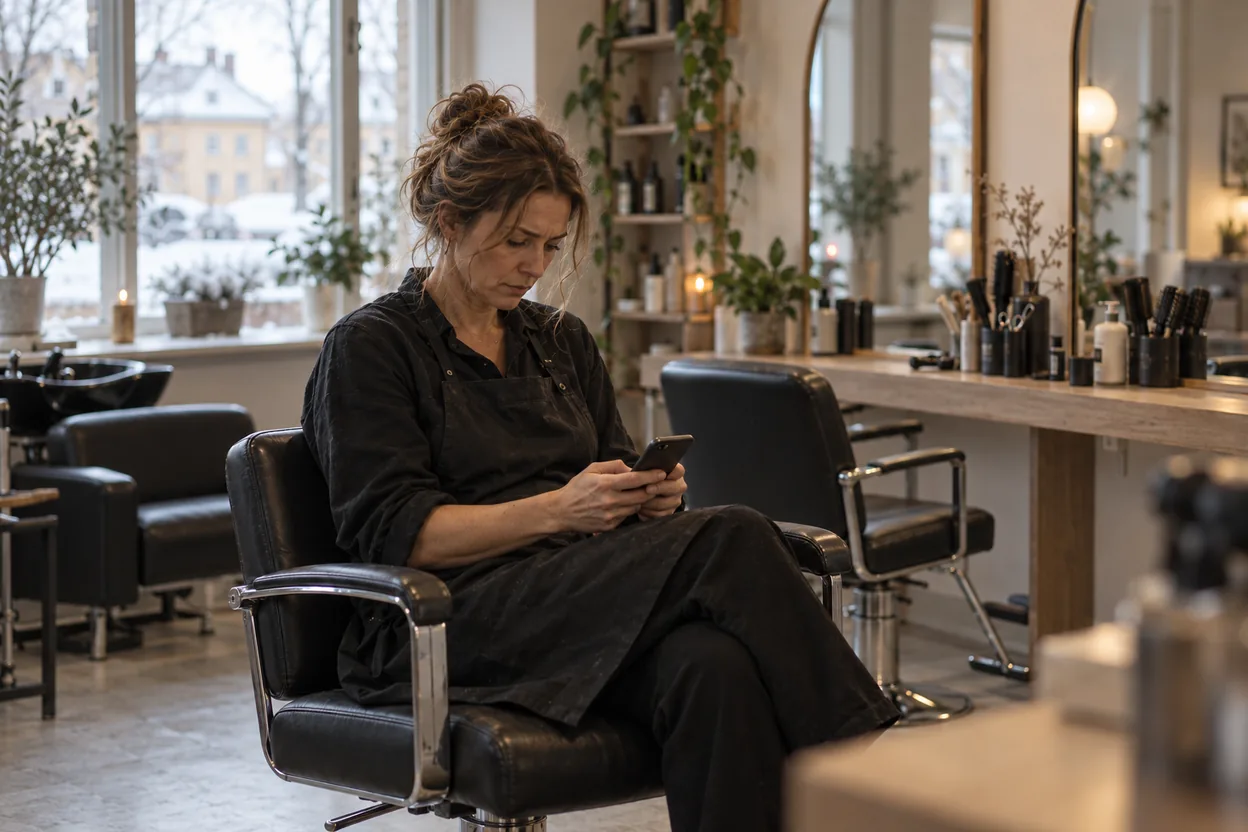
A hair salon in a mid-sized Swedish city booked fifteen new haircuts a week through a combination of Bokadirekt and Instagram. Then came a Thursday in February when the number of new bookings suddenly dropped to two. Nothing had happened in the salon. Nothing had happened with the account. But somewhere an algorithm had been adjusted, and suddenly fewer people saw the posts, and fewer found the profile in Bokadirekt’s search results.
It’s not a catastrophe story. The salon is still there, the customers are still there, the haircuts are still coming in. But a margin disappeared overnight, and the owner had no idea why, and even less of an idea what she could do about it.
That’s what it means to depend on platforms you don’t own.
You rent reach. You own nothing.
The first thing to understand is that all social channels (Instagram, Facebook, TikTok) and all booking services (Bokadirekt, Timma, Booksy) are renters of reach. They own the audience. They own the feed. They own the rules. You pay with time, content and in some cases money, to get access.
That’s not wrong in itself. They’re effective tools. A local hairdresser who isn’t on Bokadirekt misses bookings. A café that isn’t on Instagram becomes invisible to part of its audience. That’s not an argument for leaving the platforms. It’s an argument for not letting them be the only place your business exists.
What you own is something else. You own your own website. You own the email list you collect yourself. You own your Google Business Profile, in a slightly different way: Google owns the platform, but your verified ownership of the profile is durable and portable. Those are the three places where your business has a foundation that can’t be taken from you overnight.
The three things you lose when the algorithm changes
When a platform changes its rules (and they do, often), three things happen at once, often without warning.
You lose visibility. The post that last week reached 4,000 people reaches 600 this week. Nothing has changed in your work. The platform has simply decided it wants to prioritise a different type of content (shorter videos, certain music, certain formats), and your way of communicating has suddenly fallen outside the curve.
You lose bookings. A booking service can change how search results are ranked, what filters exist, which companies show up highest in a geographic area. You haven’t done anything wrong. You’ve just landed under another profile that fits the new rules better.
You lose the relationship with the customer. This is the most serious one. When a customer finds you via Instagram, and all conversation happens via DM, and the booking happens through Bokadirekt’s interface, then you have no direct contact with the customer. No email. No mobile number. No way to reach out if something changes. The day the platform changes the rules or closes your account, you’ve lost the relationship, and you didn’t even know how fragile it was.
It’s not about leaving, it’s about a foundation
It would be easy to write a piece that says “leave Instagram, leave Bokadirekt, build your own site”. That would also be wrong. Those platforms are, for many local businesses, the first thing the customer sees. Leaving them means accepting fewer bookings tomorrow in exchange for long-term stability, and few local businesses can afford that trade.
What we’re arguing for is the foundation under the platforms. A simple, professional website that’s the hub: where all information about your business lives in one place, where a new visitor can book directly, where an existing customer can find their way back without going via a platform. Social channels and booking services then become mirrors of the business, not the business itself.
Think of it this way: Bokadirekt is like a square where people pass by and might stop. Instagram is like a café where people hang out and chat. The website is your own office, where people go when they already know they want to work with you specifically. You need all three. But above all, you need the own office, because that’s where relationships are built, decisions are made and payments are completed.
What the website does that the platforms can’t
Your own website gives you four things no social platform or booking service can give:

A single source of truth. On your website you decide what shows, how it shows and in what order. No algorithms picking which post shows today. No other companies in the search result next to yours. Just your business, your tone, your photos, your words.
SEO effect over time. Search engines index and rank pages. The longer your site has existed, the more relevant content it has, the higher it ranks in Google for searches in your area. This is traffic you build over months and years and that keeps delivering even if you take a month off social media. Platform reach disappears when you stop posting. SEO reach persists.
Control over the relationship. When a customer finds your website and fills in your form or writes directly to your email, you have a direct channel. You can follow up. You can send a confirmation. You can remember who they are when they come back. You haven’t rented a relationship from Meta. You have a relationship.
Credibility no platform gives. A search for your business name on Google should lead to your site first. Not to your Instagram, not to your Bokadirekt profile, not to an old Yelp review. The first impression a potential customer gets should be something you designed, not something a platform designed for you.
What this costs, and what it doesn’t do
A common objection we hear is “but I don’t have time to maintain a website”. That’s a fair concern. We’re not arguing that you should build and run a site yourself. We’re arguing that someone should, and that the cost should be proportional to the value.
For many local businesses it’s a few thousand kronor a month for a clean, fast, easy-to-update site with integrated booking, email forms and a clear SEO foundation. That’s the same order of magnitude as a Meta ad budget for a month, but with a completely different type of return. Ads give traffic while you pay. A website gives traffic when you don’t pay.
It also means a website is not a magic solution. It doesn’t give you more bookings next week. It gives you the foundation for more bookings next quarter, next year, next decade. It’s a build, not a campaign.
How to start without abandoning anything
The first week doesn’t need to be about the website at all. It needs to be about gathering what you already have:
-
Write down all the places your business exists today. Instagram, Facebook, TikTok, Bokadirekt, Timma, Google Business Profile, Yelp, Tripadvisor, any industry sites. Where is the information correct? Where is it outdated?
-
Verify and update Google Business Profile first. It’s the only external platform where a thorough review delivers quick returns. Correct name, categories, opening hours, description, photos. That’s where 70 percent of your new customers will find you, before they even click through.
-
Start collecting email addresses. Every time a new customer books, every time someone reaches out, ask if they want an email when you have new times or offers. It’s not spam. It’s building an email list that you own and that no platform can take from you.
-
Then build the website. Not an all-singing all-dancing site with 20 subpages. A simple, honest, fast site that answers four questions: Who are you? What do you do? What does it cost? How do I book? That’s enough. More comes later.
When this becomes urgent
It’s tempting to wait until “it gets quieter at work” or “next quarter”. That’s the wrong moment to start. The right moment is when everything’s running well, because then you have the margin to build the foundation calmly. The bad moment is when the algorithm has already turned and the bookings have already dropped. Then you’re building under pressure.
The hair salon in central Sweden is still in business. She learned from that Thursday in February, built a simple website, started collecting email addresses, and today her flow is less sensitive to sudden algorithm changes. That doesn’t mean she left Instagram or Bokadirekt. She still uses them. But she no longer rents the whole of her company’s reach from someone else.
That’s the difference between being on a platform and being dependent on one.
Questions we get about this
Isn’t it just easier to keep going with Instagram and Bokadirekt? Easier short-term, more expensive long-term. You save time and money today by not building a website, but you also don’t build an asset. The day the platform changes the rules you have nothing to fall back on.
How long until a website starts having an effect? SEO is slow: count on three to six months before you see consistent organic traffic. But a website delivers value immediately in other ways: your Google Business Profile becomes more credible, your social feeds get a place to lead to, and your direct communication (email signature, business cards, Facebook bio) gets a clear destination.
Do I have to leave Bokadirekt if I build my own site? No. You can have booking both via Bokadirekt and directly on your website. Many customers find you on Bokadirekt and book there, and that’s still valuable. But new customers searching directly on Google should land on your site and be able to book there, not forced through a middleman.
What if I can’t write the texts myself? That’s not unusual. A good web producer interviews you for an hour and writes drafts based on it: you read, adjust, approve. Your voice is preserved without you having to sit at a computer yourself.
What’s a reasonable price for a website? Depending on scope: from 995 SEK per month in a pilot package for a foundational site with hosting and updates, up to custom development for businesses with many services or multiple locations. The important thing is that the cost is ongoing and predictable, not a large one-off fee that then sits untouched.
How we work with this
At Synlighetsverket we build the foundation (the website, local SEO, Google Business Profile, social presence) as one integrated practice. We don’t leave the platforms to their own devices. We make sure they lead back to a site you own yourself, so your digital presence doesn’t rest on someone else’s algorithm.
If you want to see what it would look like for your specific business, book 15 minutes. We’ll look together at where you appear today, where you’re losing customers and what the first step would be. No pressure, no commitment.