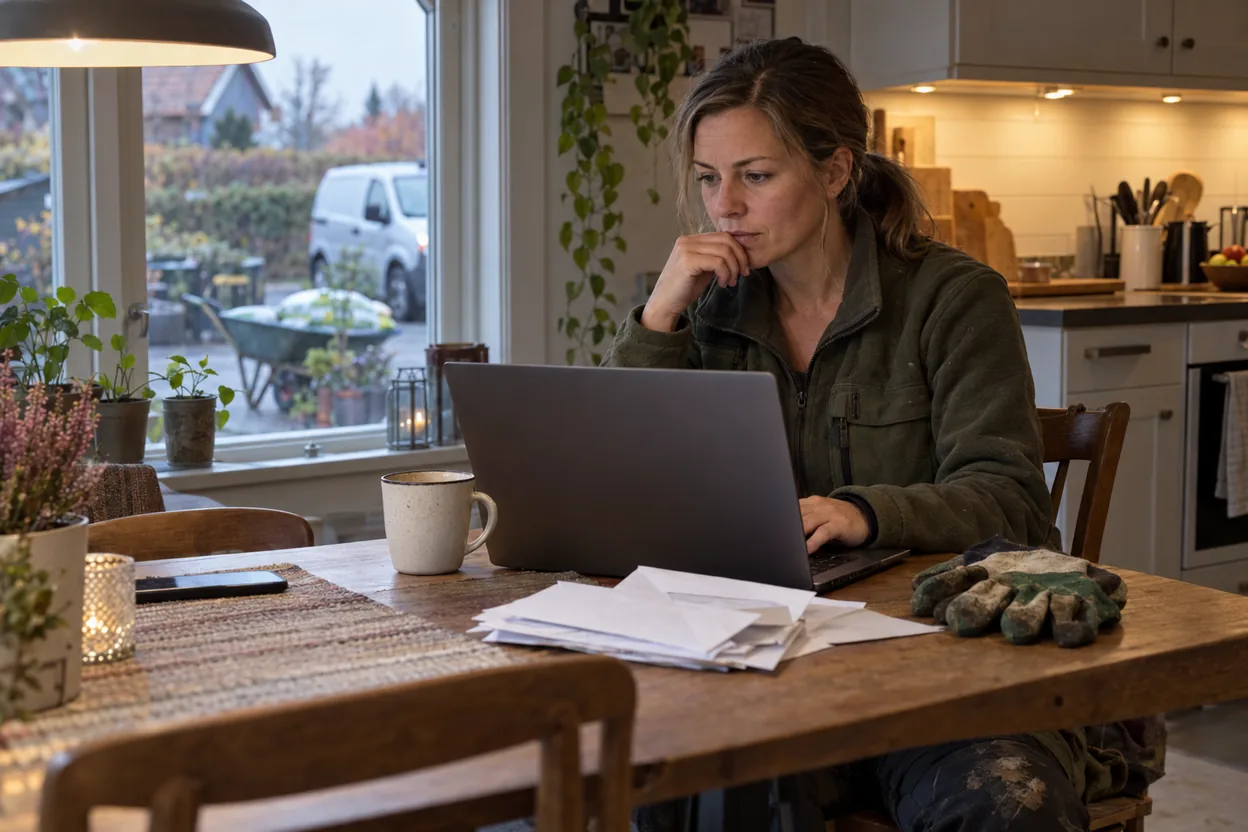
Searched for your own name and found your home address on Ratsit, Hitta and Merinfo, sometimes next to your business name? It is not a mistake in your registration. An enskild firma, the Swedish sole trader, is you as a person, and the details spread from the authorities’ registers.
This guide covers where your address shows and why, what can be removed, what you can do instead and what your website and invoices must state. It is written for English speakers running a business in Sweden, so we keep the Swedish names of laws and authorities and explain them. It is a summary, not legal advice.
As of 24 October 2026. The authorities’ pages, the legal texts and the sites’ help pages were read on 24 October 2026. The legal position for sites with publishing certificates is changing, and we update the article when something happens.
Why does my home address show when I run an enskild firma?
Because a sole trader is not a separate legal person. Bolagsverket, the Swedish Companies Registration Office, says your personal identity number (personnummer) is the business’s registration number, so everything registered about the business is also about you. The address comes from four places:
- Population registration (folkbokföring). Skatteverket, the Swedish Tax Agency, distributes this data through SPAR, the state personal address register. Hitta.se says it buys data from SPAR, and Merinfo that its data on private persons comes from suppliers who get it from Skatteverket.
- The business registers. The register kept by SCB, Statistics Sweden, covers individuals registered for F-tax (the tax status for the self-employed), VAT or as employers, with the address of each workplace. Since 26 June 2025 SCB has released it free of charge.
- Bolagsverket, if you registered the business there. The registers are public, and Bolagsverket says the data cannot be deleted to stop it appearing elsewhere.
- What you publish yourself: your Google profile, website, invoices and receipts.
| Where the address shows | Where it comes from | Can it be removed? |
|---|---|---|
| Ratsit, Hitta, Eniro and Merinfo, your page as a person | Population registration via SPAR and other sources | Several sites let you remove or hide yourself. The sites decide |
| The same sites, the business page | Skatteverket, SCB and Bolagsverket | Hitta and Merinfo say the business page is not removed. Correct it at the source |
| Bolagsverket | What you register | No, but you choose the postal address |
| Your Google profile | What you enter | Yes, if you do not serve customers there |
| Your website and invoices | What you write, with legal requirements | Partly, see below |
What you publish yourself, you can control. What spreads from the authorities’ registers, you can only partly influence.

Removing your address from Ratsit, Hitta, Eniro and Merinfo
Several of the sites let you remove or hide yourself as a private person, but Hitta says it is not obliged to, and the business page usually stays. The reason is the publishing certificates.
What a publishing certificate means
Sites with a publishing certificate (utgivningsbevis) from Mediemyndigheten, the Swedish media authority, have the same constitutional protection as newspapers, radio and TV, says IMY, the Swedish Authority for Privacy Protection. Mediemyndigheten does not review the content, and under the Swedish Data Protection Act (chapter 1, section 7) the GDPR does not apply where it would conflict with the Fundamental Law on Freedom of Expression. That is why IMY long held that it could not act against these sites.
Ratsit, Eniro and Merinfo name a responsible publisher (ansvarig utgivare), and Hitta.se says it holds a certificate. You can check any site in Mediemyndigheten’s permit register.
What the sites say themselves
- Ratsit says you can have yourself removed with BankID, the Swedish electronic ID, or through customer service. It does not change business details manually, and says details of a sole trader are deleted three years after deregistration.
- Hitta.se lets you remove your details as a private person after logging in with Mobile BankID, or by sending a copy of your ID. On the business page you can hide individual details in a business account, but the page itself is only removed once the business has ceased.
- Merinfo takes removal requests by email, but says business details cannot be removed.
- Eniro links to Ändra personuppgifter (change personal details) in its footer. We could not check what it offers, because Eniro’s pages blocked us on 24 October 2026.
Removing yourself from one site does not remove you from the others, and we have not found any site that promises a removal is permanent. Phone numbers often come from the operators, and both Hitta and Skatteverket point you to your operator for an unlisted number.
Removing the search result in Google
With Results about you, you can ask Google to remove search results showing your home address, phone number or email address. That removes the result from Google Search, not the page on the site. Google says some features are being rolled out for users over 18 in certain markets, and that results from, for example, government sites and newspapers are not removed.
GDPR and publishing certificates: the position in autumn 2026
The legal position is shifting, but nothing is settled for the address sites.
- IMY changed its view in 2024. In its legal position IMYRS 2024:1 of 14 May 2024, IMY says it can open supervision after complaints about search services with publishing certificates. It did not decide how far the GDPR applies to them.
- Four cases are ongoing. IMY is reviewing lexbase.se, krimfup.se, upplysning.se and mrkoll.se. For Upplysning.se and MrKoll, the question is whether they breach the GDPR by not deleting data on request. Meanwhile IMY does not investigate new complaints on the same issues (page updated 13 March 2026).
- The EU Court of Justice ruled on 9 July 2026. In case C-199/24, Legal Newsdesk Sweden, the Court held that member states may not exempt processing from the GDPR when the purpose is other than journalistic, academic, artistic or literary. The case concerned a paid database of criminal convictions, not addresses, and IMY is analysing what it means for its cases.
- The constitution has not changed. A government inquiry (SOU 2024:75) proposed letting parliament ban certain publication of personal data in searchable databases from 1 January 2027. According to Tidningsutgivarna, the Swedish newspaper publishers’ association, on 25 November 2025, the government is not putting forward such a proposal, and we have found no decision to amend the constitution.
In our assessment, it is worth asking each site in writing to delete your data, citing the right to erasure in Article 17 of the GDPR. IMY says the controller must respond without undue delay and within one month. Whether the site has to delete is not settled.
Bolagsverket: what is public for a sole trader
A sole trader does not have to register with Bolagsverket. Bolagsverket says you register if you want to protect your business name, and that certain larger sole traders must. Without registration, the business is with Skatteverket and SCB but not in the trade register.
If you register, the trade register contains your name, personal identity number and postal address, and the postal address of the head office (Trade Register Act, section 4). The registers are not confidential, but Bolagsverket says it does not itself make the data searchable online.
- The postal address. The law says postal address, not home address. On its page about protected personal data, Bolagsverket says the address you register does not have to be where you live, and can for example be a special postal address (särskild postadress) registered with Skatteverket. It must exist and work, and you change it at verksamt.se, the authorities’ joint business portal.
- The business name. Skatteverket suggests registering a business name so the business does not carry your personal name. The sites still link it to you through your personal identity number.
An advertising block (reklamspärr) at SPAR and Bolagsverket stops your details being released for marketing. In our assessment it does not remove you from the people-search sites, which use the data for other purposes.
Your Google profile: hide the address, show the service area
This is the easiest step if you do not serve customers at home. Google says the address in a Business Profile is public, and that a plumber running the business from home, for example, should remove it.
Choose Edit profile, Location and Business address, and turn off showing the address to customers. Then add up to 20 service areas, such as towns or postcodes, within about two hours’ drive. How a profile without an address works is covered in Businesses without a physical shop: how to handle Google Business.
- If you serve customers at home, Google generally expects you to show the address. But Google also says a business without permanent signage on site does not count as having a physical location, and should be listed as a service-area business.
- A PO box or virtual office will not do. Google’s guidelines do not allow PO boxes or mailboxes at remote locations, or a virtual office that is not staffed during business hours.
- Maps beyond Google. Bing Places also lets you hide the address, and Apple Business, Hitta and Eniro have their own listings, see Get your business on Apple Maps, Bing, Hitta and Eniro.
Your website: what the law requires
Three Swedish laws set requirements, depending on what the site does and who you sell to.
| Law | When it applies | What must be there |
|---|---|---|
| The E-Commerce Act, lagen om elektronisk handel (2002:562), section 8 | Information society services: normally provided for payment, at a distance, electronically and at the customer’s request | Name, address in the country of establishment and email. Where applicable, registration number, VAT number and licensing authority |
| The Services Act, lagen om tjänster på den inre marknaden (2009:1079), section 16 | Most service businesses, but not, for example, financial services, transport and some healthcare | Details that let customers contact you and, where applicable, registration and VAT numbers, among others. On site, electronically or in documents |
| The Distance Contracts Act, distansavtalslagen (2005:59), chapter 2, section 2 | Contracts with consumers at a distance, such as an online shop | Name, registration number, phone, address, email and the street address where customers can complain |
If information under the E-Commerce Act is missing, the Swedish Marketing Act applies (section 15). A limited company’s website must also state the company name, the town of its registered office and its registration number (Companies Act, chapter 28, section 5).
The laws say “address” and, in the Distance Contracts Act, “the street address of the place of business” where customers can turn. None of them says home address. In our assessment, a c/o address at a business centre where you can actually receive post and visitors is the safest alternative, and it is uncertain whether a PO box is enough. Have a lawyer assess your case.
For a sole trader, the registration number is your personal identity number, and we have not found a clear answer on whether it must be shown on the website. If you are VAT-registered, the VAT number must be included, and for a sole trader it is based on your personal identity number.
How to make your contact details easy for customers to find is covered in The website that actually creates customers.
Invoices and receipts: which address must they show?
Full invoice. Under the Swedish VAT Act, mervärdesskattelagen (chapter 17, section 24), an invoice must include the seller’s VAT number and the full name and address of seller and buyer, among other things. Skatteverket says the seller is normally obliged to issue a full invoice when the buyer is not a private person. The law does not say the address must be your home. Whether a PO box or c/o address works in your case is a question for Skatteverket or your accountant.
Simplified invoice. It can be used, for example, when the total is no more than SEK 4,000 including VAT, or when you are exempt from VAT because your annual turnover is no more than SEK 120,000. According to Skatteverket, the seller is then identified by VAT number, personal identity number or registration number, and an address is not required. For a sole trader that in practice means your personal identity number instead.
Receipts. If you sell more than four price base amounts a year for cash, card or Swish, SEK 236,800 including VAT for 2026, you need a cash register (kassaregister) and must offer a receipt with every sale, says Skatteverket. Invoiced sales are not included. What the receipt must contain is set out in Skatteverket’s cash register regulations, which we could not open when writing, so ask your supplier which address it must show.
The alternatives: c/o address, PO box, business centre, limited company or protected personal data
| Alternative | What it helps with | What it does not help with |
|---|---|---|
| Special postal address with Skatteverket | Post goes to a PO box or c/o address for at least six months, free, and the address can be registered with Bolagsverket | Your registered home address does not change, so it stays in SPAR and on the sites |
| PO box | A postal address for post, Bolagsverket and possibly invoices | Not accepted as the address in your Google profile |
| c/o address or business centre | An address for your website and invoices where you can be reached | A virtual office is not accepted in your Google profile unless staffed |
| Limited company | Its own registration number and address, so your personal identity number is not needed on invoices | Your name, personal identity number and a postal address are registered about you as a board member |
| Protected personal data | Protects your name and address in the population register | Granted for threats, violence or persecution, not to be less visible online |
Limited company
An aktiebolag is a separate legal person, and its postal address, which must be in Sweden, is registered with Bolagsverket. But it does not hide you. As a board member, your name, personal identity number and postal address are registered, plus your place of residence if the postal address differs (Companies Ordinance, section 3), and your private address stays on the sites. The share capital must be at least SEK 25,000 (Companies Act, chapter 1, section 5), and an annual report is filed with Bolagsverket every year. In our assessment, the address is rarely reason enough on its own to change business form, as it also affects tax, liability and bookkeeping. Talk to an accountant first.
Protected personal data
Skatteverket decides on protected population registration and confidentiality markings, and the police on fictitious identity details. They are for people at risk of violence, threats or persecution, and Skatteverket says explicitly that you cannot get them because you do not want to be visible online. If you have protected personal data, Skatteverket says you should not register the protected address as your business address.
Checklist: reduce the digital visibility of your home address
Frequently asked questions
Can I remove my address from Ratsit?
Ratsit says you can have yourself removed with BankID, the Swedish electronic ID, or contact customer service if you do not have BankID. Ratsit does not change business details manually; they are updated from the authorities’ registers. As of 24 October 2026.
Is my address public if I run an enskild firma in Sweden?
As a rule, yes. Your registered address is in SPAR, the state address register, and the business is in the Swedish Tax Agency’s and Statistics Sweden’s registers and, if you registered it there, at Bolagsverket. Bolagsverket’s registers are public, and Statistics Sweden has released its business register free of charge since 26 June 2025.
How do I hide my home address in my Google Business Profile?
If you do not serve customers at home, choose Edit profile, Location and Business address, and turn off the option to show the business address to customers. Then add up to 20 service areas. Google says a plumber who runs the business from home should remove the address, and that PO boxes and unstaffed virtual offices are not accepted as an address.
Can I use a PO box or c/o address on my invoices?
The Swedish VAT Act requires the seller’s full name and address on a full invoice, but does not say it must be your home. Whether a PO box or c/o address is enough in your case is a question for the Swedish Tax Agency or an accountant. According to the Tax Agency, a simplified invoice of up to SEK 4,000 requires an ID number rather than an address.
Can I get a protected address so I am not visible online?
No. The Swedish Tax Agency says you cannot get a confidentiality marking or protected population registration because you do not want to be visible online. Protected personal data is for people at risk of violence, threats or persecution.
Does it help to start a limited company instead?
Partly. An aktiebolag, the Swedish limited company, has its own registration number and its own postal address. But your name, personal identity number and a postal address are registered about you as a board member, and your registered home address stays on the people-search sites. The minimum share capital is SEK 25,000.
Sources
All web pages read on 24 October 2026 unless stated otherwise, all in Swedish unless marked. The sites’ help pages often have no date and may change. This is a summary of the rules, not legal advice.
- Laws
- Lag (2002:562) om elektronisk handel och andra informationssamhällets tjänster (the E-Commerce Act), riksdagen.se, sections 2, 8 and 15
- Lag (2009:1079) om tjänster på den inre marknaden (the Services Act), riksdagen.se, sections 2 and 16
- Lag (2005:59) om distansavtal och avtal utanför affärslokaler (the Distance Contracts Act), Government Offices legal database, chapter 2, section 2
- Mervärdesskattelag (2023:200) (the VAT Act), Government Offices legal database, chapter 17, sections 24, 26 and 28
- Handelsregisterlag (1974:157) (the Trade Register Act), riksdagen.se, sections 2 and 4
- Aktiebolagslag (2005:551) (the Companies Act), chapter 1 section 5 and chapter 28 section 5, and Aktiebolagsförordning (2005:559) (the Companies Ordinance), section 3, Government Offices legal database
- Skatteverket, the Swedish Tax Agency
- Skyddade personuppgifter (protected personal data) and Leva med skyddade personuppgifter (living with protected personal data, running a business)
- Uppgifter i folkbokföringen (population register data, SPAR) and Särskild postadress (special postal address)
- Momslagens regler om fakturering (VAT rules on invoicing, full and simplified invoices)
- Kassaregister, Så här använder du kassaregister and Vissa verksamheter är undantagna från kravet på kassaregister (cash registers, receipts and exemptions, four price base amounts for 2026)
- Bolagsverket, the Swedish Companies Registration Office
- Vad är en enskild näringsverksamhet? (what is a sole trader), Starta enskild näringsverksamhet (starting one) and Ändra adress för enskild näringsverksamhet (changing the address)
- Skyddade personuppgifter (protected personal data), Utlämnande av personnummer (disclosure of personal identity numbers) and Reklamspärr mot direktreklam (advertising block)
- Ändra adress för aktiebolag (changing a limited company’s address) and Årsredovisning för aktiebolag (annual reports)
- IMY, Mediemyndigheten and the EU Court of Justice
- Har du svårt att få bort uppgifter om dig från söktjänster med utgivningsbevis? (removing data from search services with publishing certificates), IMY, updated 13 February 2026
- IMY utreder inte klagomål om söktjänster medan samlad granskning pågår (IMY’s ongoing supervision of search services), IMY, updated 13 March 2026
- Rättsligt ställningstagande IMYRS 2024:1 (legal position on complaints against search services), IMY, 14 May 2024
- Dom från EU-domstolen om söktjänst med utgivningsbevis (EU court ruling), IMY, 9 July 2026, and press release 100/26 on case C-199/24 (in English), Court of Justice of the European Union, 9 July 2026
- Utgivningsbevis och databaser (publishing certificates and databases) and the permit register, Mediemyndigheten
- Legislative work
- Personuppgifter och mediegrundlagarna (SOU 2024:75) (personal data and the media constitution), riksdagen.se
- Regeringen backar om söktjänsterna (the government backs down on search services), Tidningsutgivarna, 25 November 2025 (secondary source)
- SPAR and SCB
- Uppgifter på internet, kan jag få bort dem? (data online, can I remove it?) and Mottagare av uppgifter (recipients of data), SPAR
- Företagsregistret (the business register) and Avgiftsfria uppgifter i företagsregistret (free data), SCB
- Google, Swedish versions of the help pages
- Hantera din företagsadress (manage your business address), Hantera serviceområden (manage service areas) and Riktlinjer för att företräda ditt företag på Google (guidelines for representing your business), Google Business Profile Help
- Hitta och ta bort personliga kontaktuppgifter i Googles sökresultat (Results about you) and Ta bort mina privata uppgifter från Google Sök (remove personal information), Google Search Help
- The people-search sites
- Vanliga frågor (FAQ), Ratsit
- Dölj alla mina uppgifter från hitta.se (hide all my details), GDPR, får Hitta.se publicera personuppgifter? (GDPR), Dölj uppgifter, företag (hide business details) and Din integritet (privacy policy), Hitta.se
- Om Merinfo.se (about), Merinfo
- Eniro, footer. Eniro’s help pages could not be read on 24 October 2026