A common question we get from local business owners: “Do we need to be on TikTok?” Or more honestly: “Should we post more on Instagram?”
Behind the question is a mix of anxiety (everyone else is there, are we losing out if we aren’t?) and resignation (we don’t have the time, we don’t know what to say, it feels weird). And behind the anxiety is a fundamental misunderstanding of what social media actually does for a local business.
This guide tries to give honest answers, without agency fluff and without “everyone has to be everywhere” pep talk.
The first thing that needs to be said
Social media is not an effective direct-sales channel for most local businesses. The hairdresser hoping that Instagram will drive 50 new bookings a month is almost always disappointed. The restaurant thinking TikTok will double table bookings in a month is too.
That doesn’t mean social media is worthless. It means it does something different from what it’s marketed to do.
What it does is three things:
Repetition, builds recognition over time. When a local customer sees your business pop up in their feed twice a month, it builds a sense of “I’ve seen them”. When the need arises, you’re higher up in mental ranking.
Trust, shows the business is alive and has personality. Good posts from the premises, the staff, or the work give a qualitative feeling no Google profile can give.
Mirroring, gives curious people a place to see more of you before booking. Many customers check Instagram after finding you via Google, to get a feel. A living Instagram presence strengthens the decision.
The three effects are valuable, but they’re indirect. They don’t convert one-to-one. They work as a multiplier on all other visibility.

Which platform, if you must choose one
For most local businesses, it’s better to do one platform well than four poorly. The question then becomes: which?
That depends on two things: your audience and what you have to show.
Instagram suits:
- Visually strong businesses (hairdressers, restaurants, salons, tradespeople with visible results)
- Female or mixed audiences, age range 20-55
- Businesses in cities (not small towns where Facebook still dominates)
- Businesses that can show “before/after” or “process”
Facebook suits:
- Local businesses in smaller towns
- Older audiences (45+)
- Service businesses like B2B (although LinkedIn can be better for pure B2B)
- Businesses where the local community feel is central
- Restaurants and cafés (Facebook Events still work)
TikTok suits:
- Businesses that can show something interesting to watch for 15-30 seconds, process, transformation, humour
- Younger audiences (16-35)
- Businesses in larger cities
- Businesses where “showing the work” is interesting (hairdresser cutting, chef cooking, tradesperson solving problems)
LinkedIn suits:
- B2B (lawyers, accountants, consultants, IT companies)
- Businesses where the decision-maker is a professional
- Businesses that want to build a personal brand around the founder
YouTube suits (but requires a lot of work):
- Service businesses that can share valuable information (law firm explaining rules, tradesperson showing solutions)
- Businesses that want to build deeper authority
For 80% of Sweden’s local service businesses, Instagram + Facebook is the winning combination. Both managed from Meta’s tools, the same content can usually be reused, and together they cover both younger and older audiences.
For specific industries (hairdressers in larger cities, restaurants wanting to reach the young, creative services), TikTok can be valuable as a third platform, but only if you have time to produce video content regularly.
How often you actually need to post
The second most common question: “How often do we have to post?”
The answer isn’t what social media experts usually say. For local businesses, considerably less than “every day” is enough:
- Instagram: 2-4 posts a month + 4-8 stories a month. Enough to look active.
- Facebook: 2-4 posts a month, ideally reused from Instagram.
- TikTok: 4-8 videos a month if you commit; otherwise skip entirely.
- LinkedIn: 1-2 posts a month, more curated.
More isn’t always better. Few local businesses have the material and perspective for daily posts, and thin posts are worse than fewer strong ones.
The most important thing is regularity. Better one post a week for a year than 30 posts in a month and then silence.
What to actually post
The third most common question: “What do we say?”
That’s where most local businesses get stuck. It feels like you have to come up with something creative or sales-y. In reality, simpler content works better.
Seven types of posts that work for almost every local business:
1. Before/after, for visual industries (hairdressers, tradespeople, salons, dentists). The single most effective post type, shows concretely what you do with concrete results.
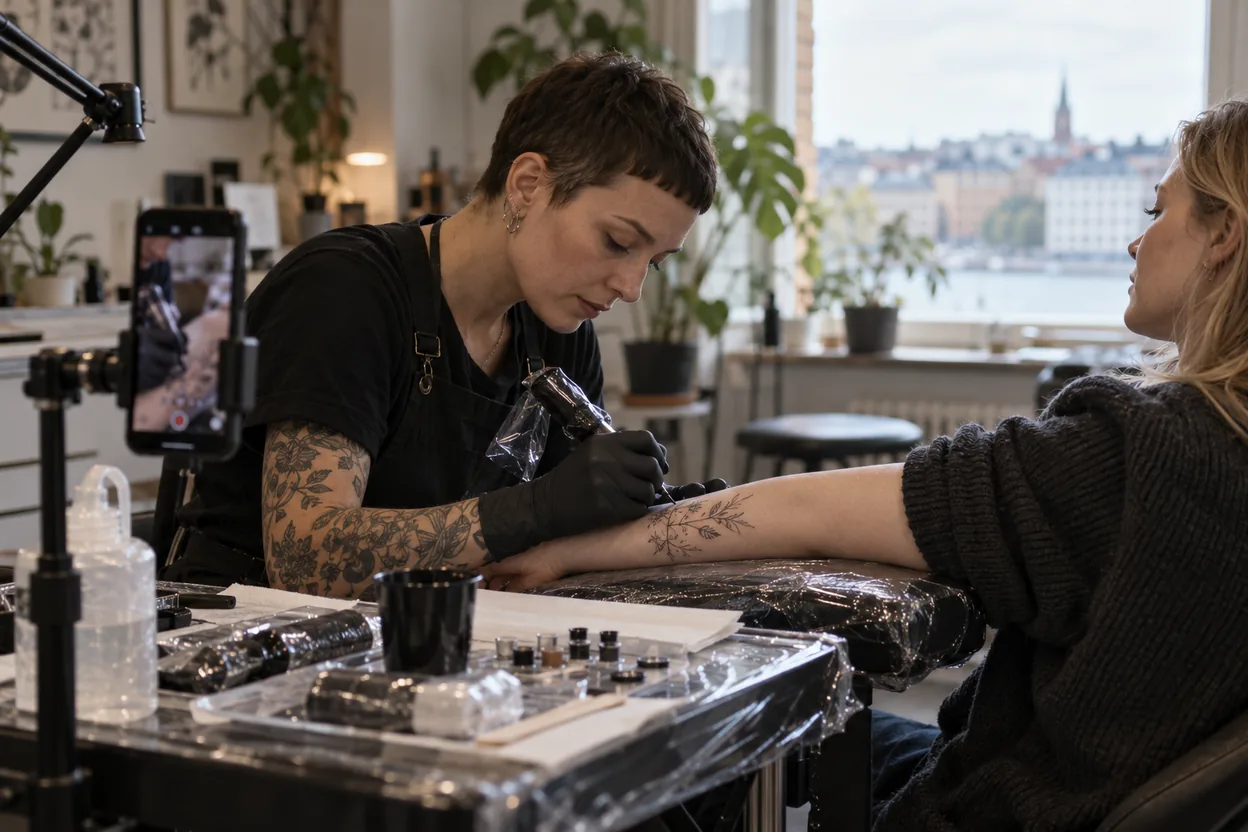
2. Process, show how the work gets done. A tattoo artist taking a quiet video of the process. A chef plating a dish. A tradesperson assembling something. It’s mesmerising to watch and builds trust.
3. The staff, people follow people, not companies. Short portraits or words from the staff. Who are you?
4. The premises, especially for place-based businesses (cafés, restaurants, salons). Different perspectives of the premises, the atmosphere, the light, the details.
5. Tips or value, something you can share that helps the customer. For a hairdresser: how to wash hair between cuts. For a restaurant: how to choose wine with the food. For a tradesperson: how to clean something specific.
6. Behind the scenes, new equipment, new staff member, seasonal prep, training you did. Shows the business is developing.
7. Customer quote or photo (with permission), a happy customer who posted something about you, a testimonial, a photo of your work in the customer’s home/business.
This isn’t revolutionary. It’s ordinary. And it’s what actually works.
What you shouldn’t post
Equally important: what doesn’t work.
- Salesy “buy now” posts, they perform poorly and damage engagement over time. Algorithms penalise them too.
- Generic “motivational” quotes, have no connection to your business and build no recognition.
- Stock photos, everyone sees them for what they are, and trust drops.
- Reposted memes without context, can work in extremely rare cases but usually just dilute the feel.
- Posts without place or business context, context is what makes the content relevant for local customers.
The biggest miss, not linking back
This is one of the biggest overlooked details in local businesses’ social media strategies: the posts don’t lead back to the website or booking.
A typical hairdresser Instagram bio might look like: just emojis, possibly a local handle, no link. Result: even when someone gets interested and wants to book, they have to guess or search for the business again.
Better practice:
- Bio: a sentence saying what you do + a link (preferably to booking or website)
- Link: use either a direct link to a specific page (Linktree if you need several) or a link to booking
- Posts: when relevant, say explicitly “Book via the link in bio” or “More info on our website”
- Stories: use the link sticker actively, it’s one of the few places direct clicks are common
For a local business, the ultimate goal of every post is either (a) to build recognition or (b) to lead to a booking or contact. Posts that don’t do (a) or (b) are wasting both your time and the customer’s attention.
Reusing, instead of inventing
The biggest operational question: “How do we have time to produce so much content?”
The answer is that you shouldn’t produce that much. The same post idea should be reused across multiple platforms:
A good post becomes 4-5 things:
- Instagram post (main variant)
- Facebook post (same material, possibly more text)
- Instagram Story (short excerpt or “behind the scenes” of the same)
- TikTok video (if the material is video, or a shorter version)
- LinkedIn post (a more formal interpretation for B2B)
One planned post = four or five posts produced. That’s the difference between being active on five platforms and drowning, or being active on five platforms and keeping up.
For video this is especially important. A 30-second video filmed in the salon can be used as:
- Reels on Instagram
- TikTok video
- Facebook video
- Story (split into two or three parts)
- A clip from it as a still image for a separate post
Same recording, four or five hours to edit, five posts.
Tool strategy, minimum viable
If you don’t have a marketing department you need a minimal tool stack. Three concrete tools that are enough:
1. The phone. The camera on a modern smartphone is superior for social content. No pro cameras needed.
2. CapCut or InShot. Free video editing apps. CapCut is especially good for TikTok/Reels.
3. Meta Business Suite. Free from Meta. Lets you plan and schedule posts on Instagram + Facebook simultaneously. Saves time and ensures you don’t forget posts when things get hectic.
For a simple content calendar a shared Notion page or a Google Sheet is enough. Complex tools like Hootsuite or Buffer are overkill for most local businesses.
Specifically for different industries
Different industries have different sweet spots on social media:
Hairdressers & nail salons
Instagram is the gold standard. Before/after, cut styles, product photos, staff. Reels drive reach; photos drive bookings. Drop-in times via Stories is an unbeatable conversion channel.
Restaurants & cafés
Instagram for photos of the food + atmosphere. Facebook for Events. Stories for today’s specials. What doesn’t work: over-edited food photos. What works: honest photos from the premises, different times of day.
Tradespeople (plumbers, electricians, carpenters)
Underrated: tradespeople who show work on TikTok or Instagram build trust quickly. Before/after of installations, problem-solving on site, common questions as short videos. Very few tradespeople do it well, which makes visibility easier.
Dentists & clinics
Careful balance. Patient photos (with permission), clinic tours, staff introductions. No “hospital photos”, people want to see safety and quality, not medical sterility. Tips posts about oral hygiene, common questions.
B2B services
LinkedIn primary, Instagram for company culture. Valuable content (insights from your field, thoughts about the industry) > “we have a new client” posts. Personal from the founder is often stronger than the company account.
Restaurants & cafés in smaller towns
Facebook still relevant, local community, event invitations, seasonal offers. Instagram as a complement for younger customers.
Measurement, what actually counts
Social media is overloaded with “vanity metrics”, number of followers, likes, reach. For a local business they’re mostly irrelevant.
What matters:
Number of new customers referring to social media. “How did you find us?”, if the answer increasingly becomes “Instagram” or “TikTok”, it’s working.
Clicks on the link in bio. Directly measurable. Shows conversion from interest to action.
Traffic from social media to the website. Visible in Google Analytics or equivalent.
Direct DMs with booking questions. Another signal that social presence is driving interest.
Ignore follower count as the primary metric. 800 local followers are worth more than 80,000 international ones.
What it means for your business
If you read all this and wonder where to start, don’t start by jumping on a new platform. Start by:
-
Take stock of what you have. Which accounts exist today? When was the last post? Is the profile complete (bio, link, contact info)?
-
Choose one platform to focus on. Not two, not three. The platform that matches your audience and your ability to produce content.
-
Set a realistic rhythm. Not “every day” if it’s unrealistic. Better “twice a week for six months” and keep it.
-
Produce a first batch of 6-8 posts. Schedule them. That gives you breathing room to focus on the rest of the business while the posts roll out.
-
Measure direct feedback. Ask new customers how they found you. Note which post types get the most reactions and DMs.
-
Adjust over time. What works? What doesn’t? Iterate.
This isn’t a replacement
A final insight worth emphasising: social media is a complement to local SEO, the website and Google Business Profile. Not a replacement.
We regularly see local businesses spending 80% of their marketing time on Instagram and 0% on Google Business Profile. They have 12,000 Instagram followers and don’t show up in the Local Pack when someone searches for them. That’s unbalanced.
A rough distribution of time and attention that works for many local businesses:
- Google + local SEO is the biggest part, where a large majority of new customers find you
- Website + booking flow handles the conversion once they’ve clicked
- Social media handles repetition and trust, multiplier, not main channel
- Everything else (ads, industry sites, local events) is a complement
The exact proportion varies per industry, a restaurant in the city centre has a different mix than a B2B consultant in the suburbs. But the order is often the same.
Social media is part of the whole, not the whole. We’ve written more about why a social-media-only dependence is risky in Why you shouldn’t depend solely on Instagram or Bokadirekt.
Questions we get about social media
Do we have to be on TikTok? No. TikTok can be extremely valuable for the right businesses (visually interesting with a younger audience), but for many local businesses it’s wasted time. Better to do Instagram well than TikTok poorly.
How often do I have to post to not lose followers? Not particularly often. For Instagram, 2-4 posts a month is enough if they’re good. Stop posting for 6 months and you don’t lose followers, just momentum. The algorithm doesn’t brutally penalise slow posters.
Is it worth paying for Instagram ads? For most local businesses, only once the organic basics are in place. Ads can accelerate reach and boost specific offers, but don’t solve underlying weakness in the profile or website. For most, the money is better spent on local SEO and Google Business Profile first.
Do I need a social media agency? For most local businesses, no. With one platform in focus and a reasonable rhythm, it’s fully manageable in-house. For larger businesses or specific campaigns external help may be worth it. For Synlighetsverket’s packages we include social presence in Plus and Premium, because it’s part of the whole, not a separate service.
What do I do if I don’t have good photos/material? Start taking simple photos with the phone. Good light, straight compositions, real subjects. Better than nothing, and better than stock. Over time you build up a library.
This is the fifth and final main guide in The Visibility Guide. Together with Digital visibility for local businesses, Google Business for local businesses, The website that actually creates customers and Reviews and trust they form the backbone of Synlighetsverket’s method.